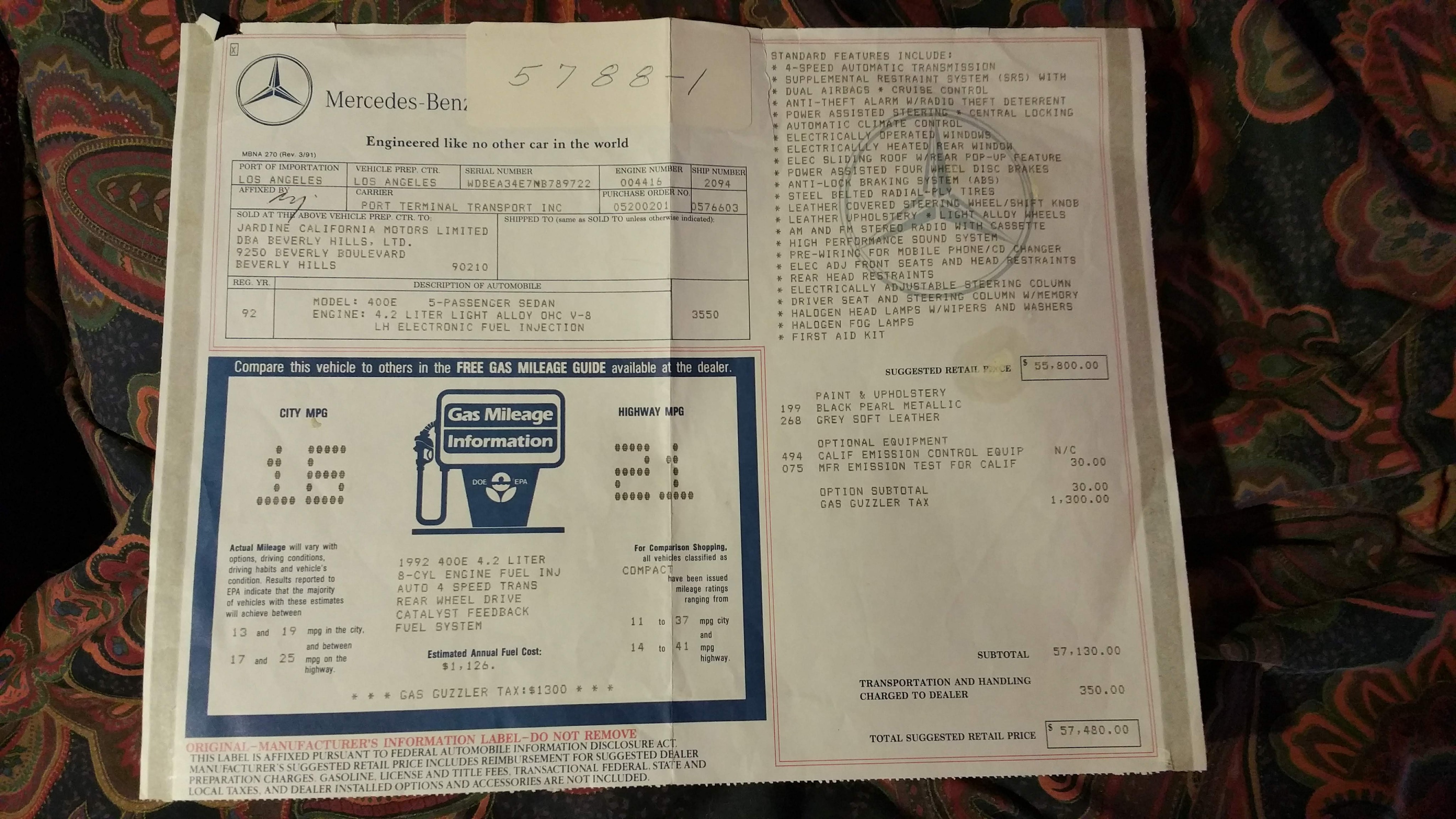
The above picture is of a “Monroney Sticker”, a bit of information required by federal law to be posted on all new vehicles that will be sold in the United States. This particular sticker is from my car, included when I purchased it from its original owner.
I may have one or two more lurking about in my departmental archive, but that’s not really important currently. What inspired this post was the editorial at the front of the issue, entitled “Take Heed, Detroit”.
In it, Mr. Woron, the then editor of the magazine, quoted a letter he received from a subscriber, who bought a car in 1955, from the same manufacturer that he’d purchased cars from during the previous two years. In this letter the writer complained of 10 m.p.g. fuel economy caused by a bad carburetor, rear windows that didn’t work properly and finally fell from their guides and into the window wells, and a chrome horn ring that rattled so badly that the owner took it off of the steering wheel and tossed it into the trunk.
In addition there were an overwhelming number of rattles, so bad the complainant said, that he’d considered advising earplugs to those who might ride with him. The column continues with Mr. Woron saying that this was the norm in those days, a far, far cry from the reports we get from enthusiasts of the era of the stony reliability of these vaunted vehicles.
The column continues: “When enough persons get sufficiently riled about the way that cars are hastily put together, the ripple is bound to grow until it breaks upon the situation like the pounding surf. And like the tides, there’s no stemming it until it turns”.
Mr. Editor Woron made reference to H.R. 10309, offered by Abraham Multer, D, NY, that outlined what we see on the sticker affixed to the windows of all new cars today. Representative Multer’s bill would have made it: “Unlawful for anyone to sell any motor vehicle in commerce unless accompanied by a by a manufacturer’s certificate of fitness.”
And then goes on to list the conditions and parameters of said certificate.
A couple of things I found interesting regarding the certificate was that the car had to be road tested for 500 miles (!), and further testing of 100 miles at speeds of 15, 30, 45, 60 and 75 miles per hour. Imagine going to a dealership and selecting a brand new car with 600 miles on the odometer. Woron went on to speculate regarding the additional employees and related costs that such an act would have tacked onto the price of a new car, then went on to say that such a bill stood good chance of passage if the manufacturers didn’t get their quality issues handled.
Woron further continues, and I’m definitely paraphrasing here, that certainly the second biggest purchase of a person’s life should be assembled at least as well as a toaster. Multer’s bill wasn’t the only one to be introduced. Monroney, as well as a representative Priest were mentioned as having introduced similar legislation, while Hank The Deuce was on record as saying that:
” There is no reason for singling out the automotive industry for regulation of this type.” Well, the automakers didn’t get the issues handled and Monroney’s bill passed in 1958. As Woron concluded the editorial: “It is just a question of time before Congress passes such a bill.”

The letters section of any magazine was where the readership would applaud, cajole, complain, or simply ask a question. In the 50’s the letters almost uniformly began with “Dear Sir”.
This formality is all but gone today, as most correspondence is done via means other than pen, paper, envelope and stamp, and social rules are far more relaxed. I snapped a pic of the letters page because it’s going to be easier to point out things and have you click on the picture and enlarge it.
Setting the tone, after the advert for the McCulloch Paxton supercharger, was a section entitled “Open Letters To The Manufacturers”, where the correspondents, a Mr. R. Blagsden of East Hampton, Connecticut, and Mr. Thomas Park, of San Bernadino, Ca, are both complaining about the quality of American cars, with the Californian bemoaning the lack of engineering originality in the domestically produced cars of that era.
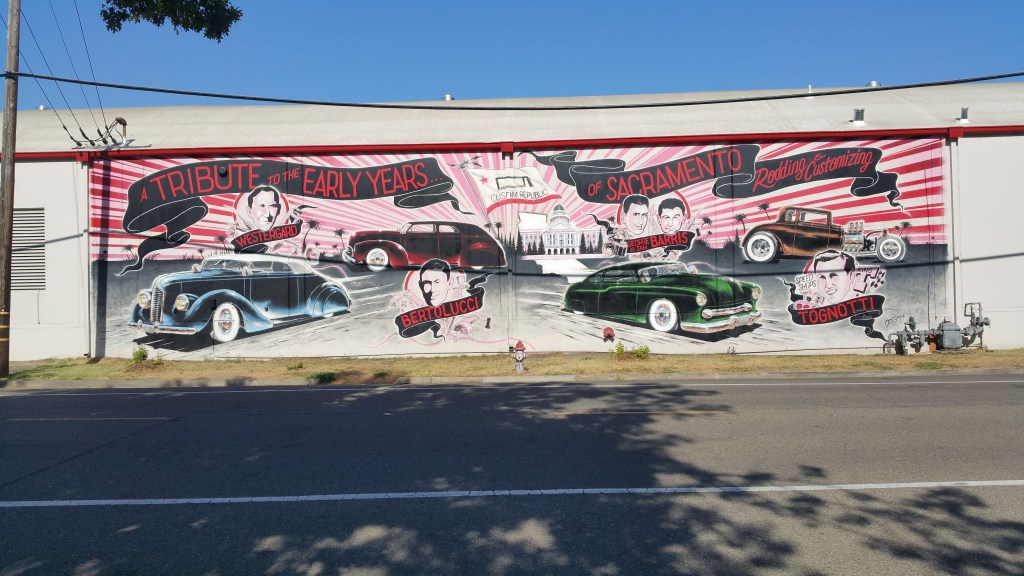
A very amusing thing, this bit of doggerel, entitled “Kan’t Kountenance Kustomized Kars”. Mr. Wallace Solum, the Illinois dwelling doggerelist, vexed mightily by the advent of Kustom Kulture, put his typewriter to task laying down nine verses of complaint. I do recommend enlarging the picture and reading it from the page. I wonder how he’d feel about the Mural on the East wall of the California Auto Museum?
There’s a shill for Chrysler, touting the safety features of its products- it’s the letter that directly follows Mr. Solum’s note, a letter that reads like ad copy without the pictures. There’s an account of misadventures in a Crosley, an argument for the survival of Studebaker-Packard, which went under in ’62, with the Hamilton, Ontario plant closing in ’66, leaving the American Motors Corporation, which would handily survive the 50’s, finally going away in the late eighties. Finally, a plea from an automotive literature collector in Yorkshire, wishing to set up correspondence with others with whom he might exchange media.
In 1956, 110 miles per hour and 0-60 in eight seconds was pretty dang impressive. That’s what this Triumph TR-3 was claiming. Dunno about the “Family Convenience” bit, though. These cars were small. Maybe if your child was under five. Five everything.


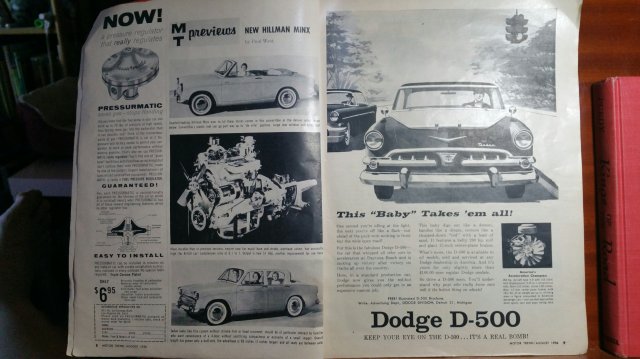
Hillman, a now forgotten (at least here in the States) British marque from the Rootes Group, shared a page with a fuel pressure regulator advert. Again, you can enlarge the pic to read the fine print for the pressure regulator, available at the low price of 6.95, Postpaid. Please enclose cash, check, or money order, after writing legibly on the teeny little cut-out coupon that was provided.
I’ve a few issues in the archive that were treated in such a manner. Again, when these were simply periodicals, we thought nothing of taking scissors to pages to obtain the keys to our prizes. Did I forget about the Hillman? So did everyone else, apparently.
I never really heard, or read much about the Dodge D-500. So, like the Hillman, loved by a small group of enthusiasts, but largely forgotten elsewhere.
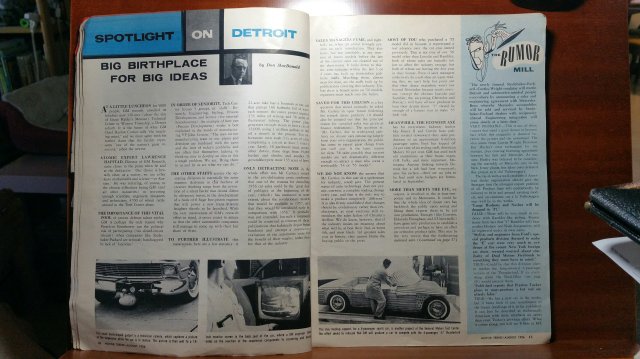
Turn the page, and there is “Spotlight On Detroit”, a monthly recap of news regarding Detroit, because that’s where the cars are made…well, in 1956 they were. Don Mac Donald edited the page, and annoyingly, a page jump, from pp11 to pp57. Argh.
Continuing past my minor aggravation, Mac Donald talks about GM’s then new Technical Center that had just opened in Warren, Mi. When it opened, the tech center covered about 320 acres, or as Mr. Mac Donald put it: “About the size of Grace Kelley’s Monaco.”
Harlow Curtice, GM’s head at the time, called it “The home of the inquiring mind” and further claimed that the tech center was “one of the nation’s greatest resources.”
Time proved this to be true, with innovations emerging from Tech Center that catapulted GM to global domination of transportation for decades. Lawrence Hafstad, then director of GM research and a physicist, complained about the chronic difficulty of finding scientists, engineers, designers and technicians to fill the center, strangely similar to complaints we hear today, except Dr. Hafstad put it thusly:
“Our choice is brutally clear; as a society, we can either learn mathematics and science- or Russian.”
At the time of the Tech Center’s opening, there were 4700 of the STEM types “rattling around”, quipped a waggish Mac Donald. The next paragraph, and I’m quoting verbatim, reads thus:
“The importance of this vital pool of proven defense talent within GM is perhaps the only reason why President Eisenhower ran the political risk of of participating ( via closed-circuit telecast ) when companies like Studebaker-Packard are seriously handicapped by lack of “facilities.” After a breakdown of the tech center “Staffs”, and mentions of the achievements made, like an ultrasonic dishwasher and “6 huge free-piston engines that will power a new trans-Atlantic freighter shortly to be launched.”
I wonder if that boat ever sailed.
The place is big. The lake on site covered 22 acres, with a fountain at one end, that pumped the equivalent of 166 bathtubs full of water per minute. (just what is a bathtub’s equivalent of water, anyway? Wouldn’t there be variances?) There was a brief description of the on-site power plant, which in 1956 used 1 million gallons of fuel oil per month to generate enough steam to (potentially) heat a city of 15,000 during the icy Michigan winters. Sympathies were extended to the window washers, ten of them, who cleaned 5.5 acres of glass, making three circuits a year, while a staff of sixteen gardeners must: “Chase dogs from 59,000 bushes and shrubs, while 55 groundskeepers mow 155 acres of lawn”…In 1956. Now the Tech Center covers over seven hundred acres, but with the technological advances fostered by the place since then, perhaps some numbers have changed.
Continuing with the spotlight, there was mention of dwindling sales in 1956, and the resulting elimination of positions in the industry, with, according to Spotlight, Ford canning 24 percent of the styling staff, with American Motors dropping a full third of their designers, while General Motors 86’d their house magazine, GM Folks, and the GM Motorama. The Motorama would return in 1959, (really ’58) and we can imagine that GM Folks never returned.
Scrambling to the back of the book, there’s news on tires, specifically, tires that promise to eliminate the need for spare tires. The idea was a “tire within a tire” as put forth by Goodyear, which was an adaptation from a competitor, Firestone.
From what I was able to suss out of the read, it’s basically a tougher tube ( bias belted, tubed tires were the norm then) with 2 plies, enabling one to travel safely to a repair location. There was also mention of self-sealing being discarded by Goodyear, some mumbling about a Firestone patent, as well as Goodrich trying to collect on the invention of the tubeless tire.
In 1956, a full 25 percent of AAA’s calls were for flats. The proposed tech was going to reduce that, and it was worth the premium to spend on the tire to potentially eliminate hazardous tire changes in areas where there wasn’t much space, like narrow roads without shoulders, bridges, or expressways.
More power for some of the Mercury lineup, Montereys and Montclairs as well as Customs and Medalists aT slight bump, 10 horses for each.
Closing out the column is news of racing tires being made available more generally, with Firestone and Goodyear both getting mentions.
Next over on the page before the jump is “The Rumor Mill”, with the lead being news of the Studebaker-Packard combine potentially entering into an agreement with Mercedes-Benz to sell and service Mercedes vehicles through Studebaker-Packard dealers with reciprocity abroad…here’s some linky goodness:
https://www.automobilemag.com/news/mercedesbenzs-connection-with-studebakerpackard-134155/
There were a couple of other entries one dealing with Hudson/Nash, and a bit about Ford stylists; interesting re the Ford guys, because they were worried about the Dual Motors Firebomb bearing a similarity to something that they were working on. Dual? I hear you say. Yes, Dual, an American manufacturer lost to time, like the aforementioned BMC, but not before collaborating with Ghia of Turin to manufacture a very striking car called the Dual-Ghia, a car which Sinatra adored.
Preston tucker also got a mention, with the rumor that he was planning a Hot Rod being dismissed as false, just a safer, updated version of Tucker’s first effort.
In another department, called “The Glove Compartment”, Pete Molson reported, among other things, That Vogue tires were made by Denman. A Mr. Dodson, representing Vogue, Corrected Mr. Molson, saying that Vogue was indeed its own manufacturer. China was going to start building its own car, after a practice run with Soviet parts, Teflon was discovered to have lubricating powers, and supercharging helps cut down on diesel soot in smoggy Los Angeles. Have a look for yourself:
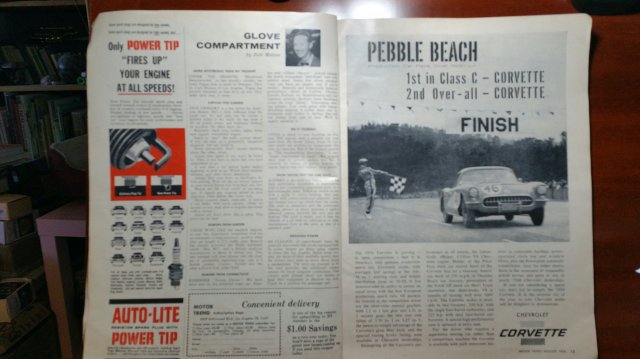
The Corvette ad was particularly interesting, in that it was written for the road-racing types, with engine displacement being given in liters, rather than cubic inches, as was the norm at the time. 4.3 liters is close enough to 265 cubic inches, which was the size of the then-new Chevy small-block engine. Again, have a click and read through.
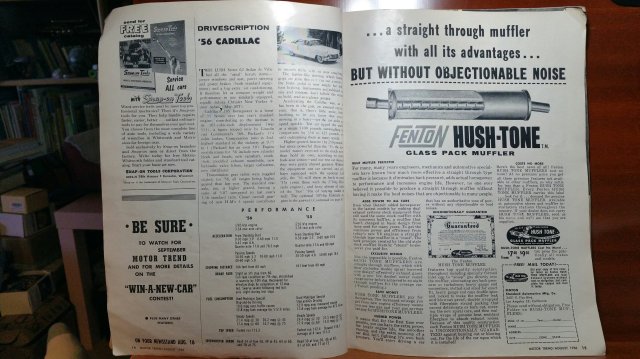
Leafing through pages, one passes by a short test of a 1956 Cadillac, a drivescription as it’s called, directly comparing a 1956 to a 1955. If you like comparisons year-to- year, then you might enjoy this. I’m getting a kick out of the muffler ad on the facing page, as well as the Snap-On Tools ad It even says on the bottom of the very small ad, asterisked, that *Snap-On is the trademark of Snap-On Tools Corporation. Again, an image waiting for a click to enlarge.
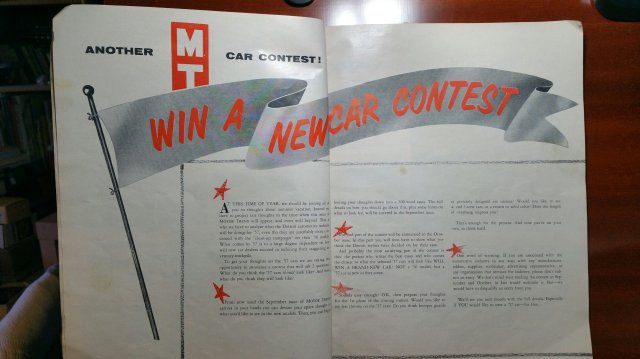
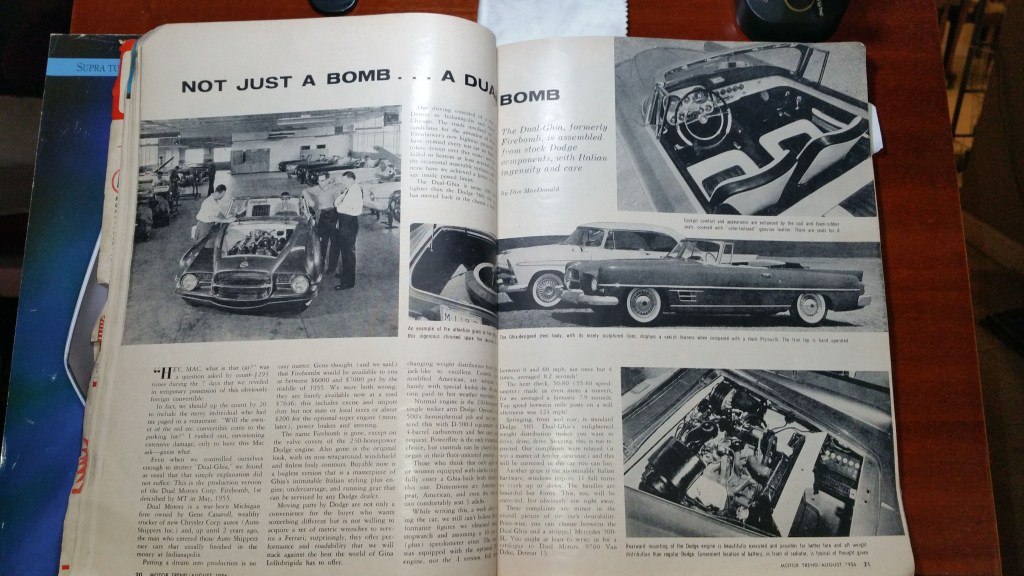
I mentioned the Dual-Ghia earlier. Here’s the spread, a quick story by McDonald that begins with the question that any driver of an unusual vehicle will get every now and again- What is it? Putting the question into fifties parlance, and quoting directly from the lead-in: “Hey, Mac, what is that car?” My pops had to tell me when I was a boy that “mac” was how one addressed a male that one didn’t know. That manner of address has left us, thankfully.
The Dodge 500 is mentioned again, this time in comparison to the Dual-Ghia, which had its engine moved back several inches compared to the Dodge, and it also says that the Hemi was available as an option in the Dual-Ghia. Of course, there are also gripes, mostly regarding the window winders. There is an address to write to to request further info, and it is: Dual Motors, 9760 Van Dyke, Detroit, 13.
Following that is a report on the 1956 Indy 500, again by Mac Donald. TL/DR- Pat Flaherty in the John Zink Special took the prize of 93,819 Dollars at an average speed of 128.490 miles per hour.
And now to the interesting stuff. Following several pages of photos and paragraphs regarding cars from The Continent and England, two stories caught my eye. But first, the photos.


